
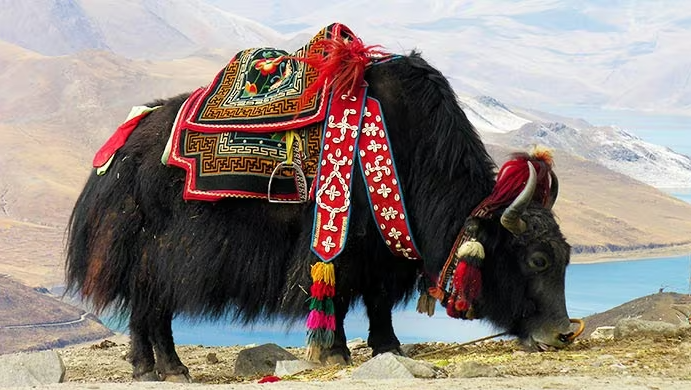
The Tibetan Plateau is one of the highest and most challenging places in the world to raise livestock. Cold winters, fragile grasslands, and the growing impacts of climate change make herding a demanding way of life. Due to the unique conditions on the Tibetan Plateau, many adaptation strategies that have worked elsewhere are unsuitable here.
Our research focused on 682 herder households in the Pumqu River Basin to explore the role of livestock diversification—keeping a mix of animals such as yaks, cattle, sheep, and goats—as a way to adapt to these conditions. Although diversification has long been part of Tibetan herding traditions, its potential as a climate adaptation strategy had not been fully examined.
The study found that diversification is widespread and is largely driven by opportunities rather than desperation. Households with more labour, better equipment, warm sheds, barns, and access to government support are more likely to keep a variety of animals. While changes in climate and the environment can also influence decisions, the pull of better resources and support is stronger. Diversification tends to increase total livestock numbers, which strengthens livelihoods and allows families to reinvest in their herds. Over time, this creates a cycle in which improved resources and more resilient herds reinforce each other.
These findings suggest that, in the right conditions, diversification can be a proactive and sustainable way for herders on the Tibetan Plateau to adapt to climate change and maintain their way of life.
Read the full open access paper here:
Yu, Y., Yan, J., Akin, S., Liu, H. & Martens, P. (2025). Livestock Diversification works as a helpful livelihood strategy for herders on the Tibetan Plateau: Implications for climate change adaptation. Sustainable Futures, 10, December 2025, 101116. https://doi.org/10.1016/j.sftr.2025.101116
 PIM MARTENS