Category Archives: consumer behaviour

Understanding food cultures are important for reducing dietary environmental impacts

Our food consumption patterns play a major role in determining both human and planetary health. A substantial body of evidence has shown that the current worldwide food consumption is not only contributing to 19–29% of greenhouse gas (GHG) emissions, but is also responsible for using 37% of the Earth’s landmass.

Furthermore, worldwide rising income and urbanization have contributed to the dietary transition from plant-based products to more animal-based diets, and the category of “meat and meat products” contributes most to the environmental footprint in many parts of the world. The situation is expected to get worse as more populations are experiencing dietary transition, resulting in asymmetrical environmental degradation around the world.

Our study highlighted the importance to better understand the effects of geographical location and related food cultures for reducing the dietary environmental impacts. The present study also indicated that meat was the main source of the dietary environmental footprint in contemporary China, while the over-consumption of meat is severe for all groups of Chinese people.

Reversing this trend in China and other countries, and increasing the consumption of foods that are consistently associated with low environmental impacts, would undoubtedly have multiple environmental benefits. Hence, more interventions that seek to change people’s food consumption behaviors are specifically needed. This will require a better understanding of how individuals’ dietary behaviors are influenced by the interaction effect of economic conditions and dietary cultures within which individuals are embedded, not only in China but also in other countries with diverse food cultures.

Read the full paper here: Su, B., Zhang, C., Martens, P. & Cao, X. (2023). How economic and geographical indicators affect dietary environmental footprint: Evidence from China. Ecological Indicators, Volume 148, April 2023, 110075, https://doi.org/10.1016/j.ecolind.2023.110075

The dietary ecological footprint 

Food consumption is increasingly impacting the environment. Our results for China, together with previous findings, demonstrate that dietary patterns could contribute directly and significantly to the dietary Ecological Foot Print (EFP), and animal-based diets have greater environmental consequences in terms of land use than plant-based diets.

This study highlights again the dominant role of meat consumption, especially pork and seafood, in dietary patterns, suggesting that China has entered an era dominated by animal-based products. India, as another fast-developing country with the second-largest population, however, did not consume much meat, fish, or eggs. This resulted in a relatively lower environmental footprint for Indian people than for Chinese people. Although dietary choice is a personal matter, owing to the increasing environmental concern, individuals are motivated to change their dietary patterns. A transition to eating less meat would therefore reduce the negative environmental impacts. However, rising incomes and urbanization are driving a global dietary transition in which traditional diets are replaced by diets higher in refined fats and meats. This trend is especially significant in developing countries like China, Nigeria, India, Indonesia, and Mexico.

Graphical Abstract

In light of the generally continually increasing income, diversity dietary cultures, and dietary transitions, the impacts on environmental resources of meat consumption will be severe. Hence, incentives should focus on improving people’s awareness of sustainable dietary patterns. 

Read the full paper here: Su, B., Zhang, C., Martens, P. & Cao, X. (2022). A comparative study on the dietary ecological footprint in contemporary China. Science of the Total Environment, 851 (2), 158289.

Human behaviour in relation to waste management

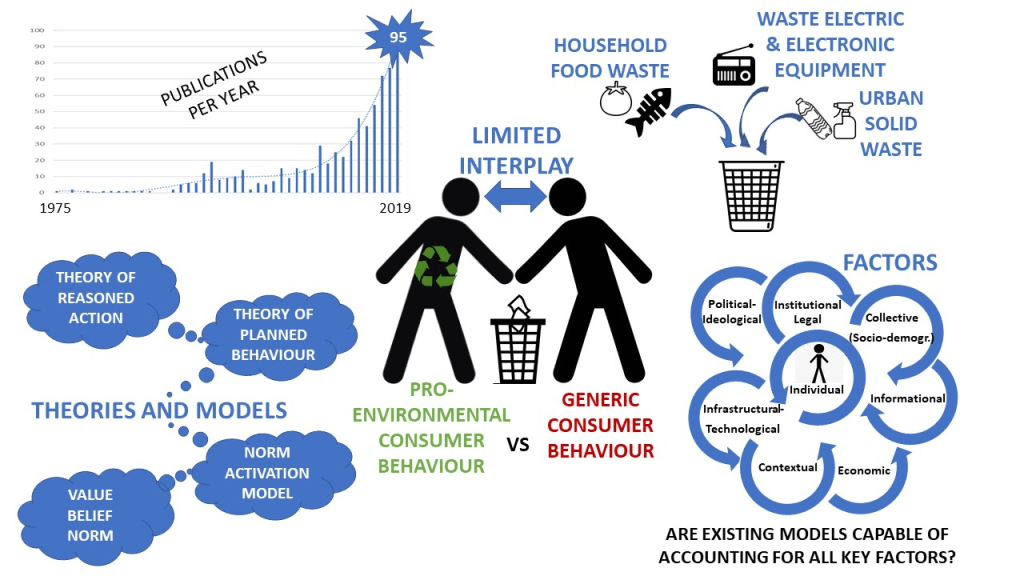
In recent years, the research on human behaviour in relation to waste management has increased at an exponential rate. At the same time, the expanding academic literature on this topic makes it more difficult to understand the main areas of interest, the leading institutions and authors, the possible interconnections among different disciplines, and the gaps. The paper below maps knowledge domain on recycling behaviour through bibliometric analysis and text mining in order to identify current trends, research networks and hot topics. 2061 articles between 1975 and 2020 from three different databases are examined with an interdisciplinary approach. The findings reveal that 60% of papers have been published between 2015 and 2020, and this topic is of global interest. Leading countries are mainly located in Europe, North America and Commonwealth; however, China and Malaysia are also assuming a driving role.

Bibliometrics and text mining provide the intellectual configuration of the knowledge on recycling behaviour; co-word analysis individuates conceptual sub-domains in food waste, determinants of recycling behaviour, waste management system, waste electrical and electronic equipment (WEEE), higher-level education, plastic bags, and local government. Overall, waste management and related human behaviour represent a universal challenge requiring a structured and interdisciplinary approach at all levels (individual, institutions, industry, academia). Lastly, this paper offers some suggestions for future research such as smart city design, sensor network system, consumer responsibilisation, the adoption of a more comprehensive view of the areas of investigation through the holistic analysis of all stakeholders.

Read the full paper here: Alessandro Concari, Gerjo Kok & Pim Martens. (2022). Recycling behaviour: Mapping knowledge domain through bibliometrics and text mining. Journal of Environmental Management, Volume 303, 114160.

Pro-environmental consumer behaviour : the need for an interdisciplinary approach

In the last few years a steady increase in studies on consumer behaviour, in relation to sustainable development, demonstrates the need to expand the economic and social analysis of consumer activities towards a more interdisciplinary approach. In some cases like environmental engineering, we observe great progress, but note with regret that the predominant focus is still on the consumer purchase phase.  Similarly, economic studies tend to consider the individual as a rational actor maximising his/her profit or interest. In general, the analysis of human behaviour is influenced and biased by the different sectorial perspective adopted by the scholar. A correct analysis of the impact of all human consumptive activities on the environment requires an interdisciplinary approach involving many fields like engineering, chemistry, ecology, economics, marketing, law, business management, sociology, and psychology.

Read more in: Concari, A., Kok, G., Martens, P. (2020). A Systematic Literature Review of Concepts and Factors Related to Pro-Environmental Consumer Behaviour in Relation to Waste Management through an Interdisciplinary Approach. Sustainability12, 4452.