
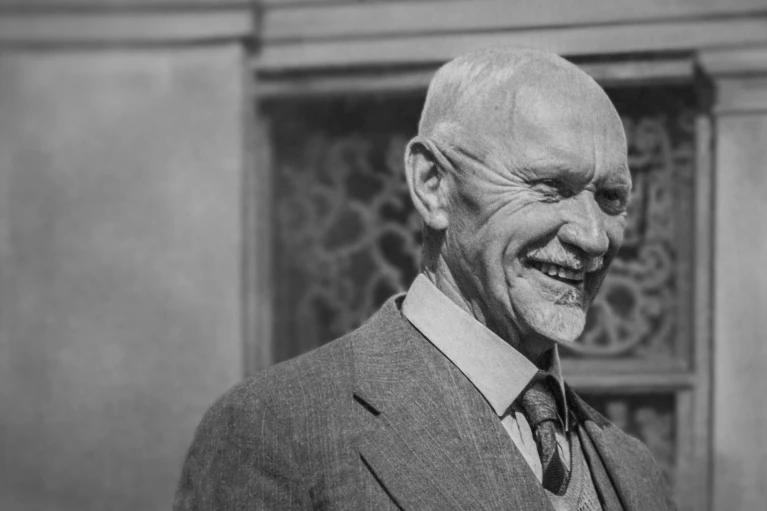
In 1926, a South African statesman named Jan Smuts published a bold theory about how the universe works. He called it holism, and while the word has since been hijacked by wellness culture, the original idea was serious science, a century ahead of its time.
Smuts noticed something that bothered him about mainstream science: it was very good at taking things apart, but struggled to explain how complex, organised things came together in the first place. How does a handful of atoms become a living cell? How does a cell become a mind? His answer: nature has a built-in tendency to form wholes – integrated structures that are genuinely more than the sum of their parts, not just in a poetic sense, but causally.
In other words, evolution isn’t only driven by random variation and natural selection. Something in the fabric of nature, Smuts argued, actively channels matter and energy toward organised, structured forms.
For most of the twentieth century, this sounded too mystical to take seriously. But here’s what’s changed: science now has the mathematical tools to ask Smuts’ question properly. Fields like dynamical systems theory and complexity science have shown how order genuinely does emerge from simpler components, and researchers are increasingly asking whether nature might be biased toward organisation, not just accidentally compatible with it.
As the hundredth anniversary of Smuts’ book arrives, his core question looks less like speculation and more like one of the deepest unsolved problems in science: why does the universe keep building increasingly complex, integrated structures, and is there a law behind it?
Read the full paper: Dos Santos, M., Weyers, P.J. & Martens, P. (2026). Holism at One Hundred: Jan Smuts, evolution, and the dynamics of organisation. Nature Africa, https://doi.org/10.1038/d44148-026-00101-3
 PIM MARTENS
Dag Pim,
Ik ben nieuwsgierig! Dank ook voor dit artikel!
Ik zie Jan Smuts dan mogelijk in lijn met Ken Wilber, Fredirico Faggin, Bernardo Kastrub, Ervin Lazlo, Ullrich Liebregts, Dr. Yogi Hendlin etc.
Mijn reizen met diverse planmedicijnen hebben mij de afgelopen 4 jaar enorm geholpen bij integratie en persoonlijke ontwikkeling m.b.t integraal bewustzijn en leef,-werkstijl. Ik heb binnen mijn werk een jaartraject Natuurlijk Leiderschap voor leidinggevenden binnen het zakenleven ontwikkeld. Ik wilde je al eerder benaderen om daar ook de voedelsbossen in te betrekken. Mogelijk in het tweede jaar!
Ik dacht ik mail je weer eens: Mocht je zelf interesse hebben of deelnemers kennen met interesse voor een kleinschalige retraite met lichaasmbewustzijn, intergenerationele gedragspatronen en een gedegen truffelceremonie, dan wees welkom in Mechelen!
Ik organiseer retraites met lichaamsgerichte psychotherapeut Bram de Groote uit Antwerpen (met achtergrond religiewetenschappen, oosterse bewegingsleer, sjamanisme en docent AWE aan Universiteit Mexico). Zie flyer. Hij is erg bekwaam en goed (niks esoterie etc) . Afijn, wilde het je laten weten!
met vriendelijke groet,

Mw. Daan Wierenga van IJzendoorn PHAROS Integrale coaching en training Bommerigerweg 13 6281 BR Mechelen (Zuid Limburg) T: 06 231 96 412 M:daan@pharoscoaching.nl http://www.pharoscoaching.nl NOBCO/EMCC/IFC/BIG gecert. snr. coach CRKBO erkend docent

>