
Category Archives: wildlife

Voedselbos Als Dierenapotheek: Wat Zegt De Wetenschap?

Dit artikel is verschenen in het Voedselbossen Magazine, 2025, 3(4), 12-14.

Dieren in het wild hebben vaak een opmerkelijk instinct voor wat goed voor ze is. Ze herkennen geur, smaak en soms de werking van planten of mineralen in hun omgeving. Dit natuurlijke zelfzorggedrag wordt in de wetenschap zoofarmacognosie[i] genoemd: het gebruik van natuurlijke stoffen door dieren om ziekten, parasieten of andere gezondheidsproblemen te bestrijden.[ii] Het is gezien bij apen, olifanten, vogels en zelfs insecten.[iii] En dichter bij huis? Ook in Nederland vertonen dieren soms gedrag dat hierop lijkt. In voedselbossen speelt dit principe ook een rol: een diversiteit aan kruiden, struiken en bomen trekt dieren aan die zelf weten wat ze nodig hebben, terwijl hun aanwezigheid tegelijk bijdraagt aan het evenwicht en de gezondheid van het ecosysteem. Wat voorbeelden.

Das(look)

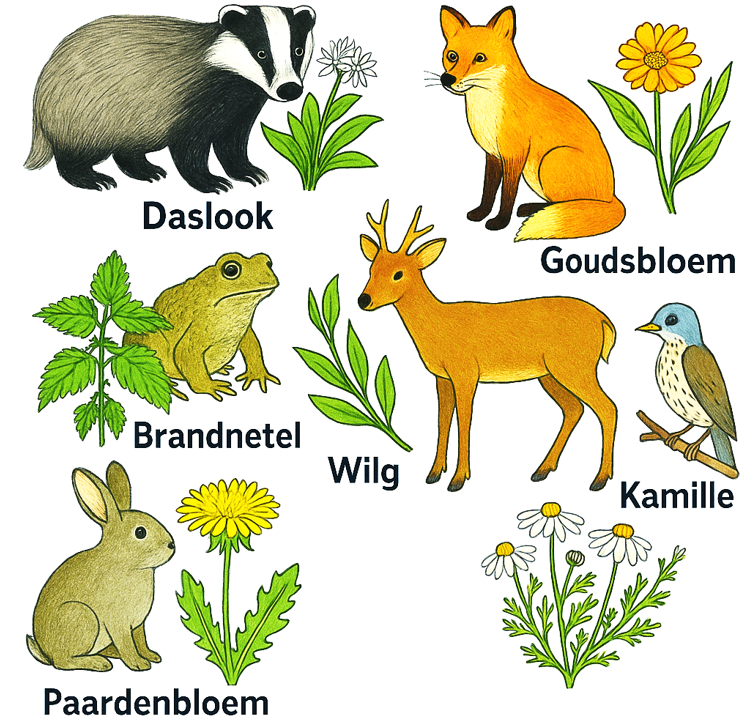
In het vroege voorjaar, wanneer de bladeren van daslook uit de grond komen, eten dassen ze graag. Ze graven ook de bollen op. Daslook bevat zwavelverbindingen zoals allicine, bekend van knoflook, die antimicrobieel en mogelijk wormafdrijvend werken. Hoewel er geen hard wetenschappelijk bewijs is dat dassen dit bewust doen om zich te ‘ontwormen’, is het aannemelijk dat het hen helpt na de winterslaap, wanneer darmparasieten vaker voorkomen. Ook wilde zwijnen zijn dol op daslook, mogelijk om vergelijkbare redenen.[iv]

Zelfmedicatie bij egels

Ook egels tonen mogelijk gedrag dat geïnterpreteerd kan worden als zelfmedicatie. Hoewel zij vooral insecten en slakken eten, zijn er observaties van egels die zich actief inwrijven met bladeren van aromatische planten zoals duizendblad, kamille of valeriaan. Deze planten bevatten insectenwerende en schimmelremmende stoffen. De exacte reden is nog niet bewezen, maar het past bij het bredere beeld dat dieren stoffen uit hun omgeving benutten om gezond te blijven.

Reeën, herten en natuurlijke pijnstillers

Grote herbivoren zoals reeën en edelherten knagen geregeld aan jonge wilgentakken. Wilgenbast bevat salicine, dat in het lichaam wordt omgezet in salicylzuur – verwant aan aspirine en bekend om pijnstillende en ontstekingsremmende werking. Hoewel we niet precies weten of herten dit extra eten bij pijn, krijgen ze er wel degelijk een natuurlijke pijnstiller mee binnen. Ze eten ook geregeld brandnetels, vooral als de bladeren jong of verwelkt zijn. Brandnetel is rijk aan mineralen zoals ijzer en magnesium en staat bekend als bloedzuiverend en ondersteunend voor de stofwisseling.

Kleine zoogdieren en wilde kruiden

Kleine herbivoren zoals konijnen en hazen eten vaak planten die ook geneeskrachtig voor mensen zijn. Paardenbloem werkt mild vochtafdrijvend en ondersteunt de lever. Grote weegbree bevat stoffen die verzachtend en ontstekingsremmend werken, zowel bij maag-darmklachten als bij wondjes. Mogelijk profiteren de dieren van deze eigenschappen, maar of ze de planten bewust kiezen bij ziekte blijft lastig te bewijzen.

Vossen

Over vossen is minder bekend, maar er zijn meldingen van kruidenresten zoals kamille en goudsbloem in hun burchten.[v] Beide planten bevatten stoffen die ontstekingsremmend en antimicrobieel zijn. Het gebruik van specifieke planten door vossen blijft vooralsnog vooral een plausibel vermoeden.

Nestmedicatie

Bij sommige vogels is het verband wél goed aangetoond. Soorten als de huismus, koolmees en spreeuw verwerken bewust aromatische planten zoals lavendel, salie of kamille in hun nesten. Deze kruiden bevatten geuren en stoffen die bacteriën en parasieten weren. In stedelijke gebieden gebruiken mussen zelfs sigarettenfilters, waarbij het nicotine insecten doodt.[vi] Onderzoek toont aan dat nesten met zulke materialen minder last hebben van bloedmijten en luizen, en dat de kuikens gezonder opgroeien. Dit gedrag wordt nestmedicatie genoemd.

Amfibieën en microhabitats

Bij amfibieën zoals kikkers en padden is direct bewijs voor zelfmedicatie schaars. Wel kiezen sommige soorten modderige plekken of bodems die rijk zijn aan mineralen of plantenresten, mogelijk om de huid te beschermen tegen infecties. Dit blijft voorlopig een hypothese, maar is ecologisch goed voorstelbaar.

Rupsen en bijen

Rupsen van Nederlandse vlinders (zoals de dagpauwoog, kleine vos, atalanta en gehakkelde aurelia) eten brandnetel vooral omdat het hun vaste waardplant is. Sommige rupsen eten echter meer van een giftige plant zodra ze geïnfecteerd zijn, wat duidt op echte zelfmedicatie.[vii] Het is dus denkbaar dat Nederlandse brandnetel-etende rupsen dit ook doen, maar daar is nog weinig direct onderzoek naar.

Honingbijen verzamelen propolis, een hars uit planten, en gebruiken dit in hun nest. Deze stof werkt sterk tegen bacteriën en schimmels en helpt de bijenkolonie gezond te houden.[viii]

Het voedselbos als natuurlijke apotheek

In een voedselbos groeit een gevarieerd aanbod van voedselplanten, waaronder kruiden met geneeskrachtige eigenschappen. Deze planten zijn niet alleen waardevol voor mensen, maar ook voor dieren. Voedselbossen kunnen dus een plek zijn waar dieren vinden wat ze nodig hebben, niet alleen qua voedsel, maar ook voor hun gezondheid. Zoofarmacognosie, iets om misschien rekening mee te houden in het ontwerp van onze voedselbossen?


[i] Raman, R. & Kandula, S. (2008). Zoopharmacognosy: Self Medication in Wild Animals. Resonance, March, 245-253.

[ii] Zie ook: Wikipedia: https://en.wikipedia.org/wiki/Zoopharmacognosy

[iii] Huffman, A.H. (2021). Folklore, Animal Self-Medication, and Phytotherapy–Something Old, Something New, Something Borrowed, Some Things True. Planta Medica, 88, 187-199.

[iv] Băieş, M.H., Cotuţiu, V.D., Spînu, M. et al. (2024). In vivo assessment of the antiparasitic effects of Allium sativum L. and Artemisia absinthium L. against gastrointestinal parasites in swine from low-input farms. BMC Veterinarian Research,  20, 126 (2024). https://doi.org/10.1186/s12917-024-03983-3

[v] Zie ook: https://www.blackfoxes.co.uk/photography-ethics.php

[vi] Water, H. (2013). Bird Butts. Scientific American, Feb 1. https://www.scientificamerican.com/article/cigarette-butts-help-birds-ward-off-parasites/

[vii] Singer, M.S., Mace, K.C. & Bernays, E.A. (2009). Self-medication as adaptive plasticity: increased ingestion of plant toxins by parasitized caterpillars. PLoS ONE, 4(3). https://doi.org/10.1371/journal.pone.0004796

[viii] Simone-Finstrom M., Borba R.S., Wilson M., Spivak M. (2017). Propolis Counteracts Some Threats to Honey Bee Health. Insects, 8(2):46. https://doi.org/10.3390/insects8020046

Nature’s Guardians: How Predators and Scavengers Protect Planetary Health

When we think of wolves, vultures, bats or goannas, we might picture danger, disease, or inconvenience. But science is telling us a different story — one that positions these often-feared species as unsung heroes in the fight for a healthier planet.

Our recent paper published in BioScience argues that predators and scavengers play vital, underappreciated roles in maintaining ecological balance and even safeguarding human well-being. Far from being threats, these species are ecosystem regulators, quietly delivering public health benefits and economic value.

From Pest Control to Public Health

Take bats, for example. After bat populations in North America were decimated by white-nose syndrome, farmers had to compensate for lost insect control by using more pesticides. The result? A spike in agricultural costs — and alarmingly, a possible 8% increase in infant mortality in affected regions. The link? More insecticides, more environmental exposure, more risk.

And the vultures of India? Their rapid decline in the 1990s (due to a veterinary drug called diclofenac) caused livestock carcasses to pile up, triggering sanitation crises. Researchers estimate this led to over half a million human deaths and a $69 billion economic impact.

Biodiversity That Pays Off

It’s not just about disease. Predators like the New Zealand falcon help protect vineyards from grape-eating birds. Wolves reduce wildlife–vehicle collisions, saving human lives and insurance costs. Even reptiles like the Australian heath goanna help farmers by consuming fly-attracting carcasses that would otherwise impact livestock.

In short: these animals provide services — pest control, waste removal, disease regulation — that we’d otherwise have to pay for. And often, we’re not even aware of their silent labor.

A Call for Smarter Conservation

Yet despite these benefits, predators and scavengers are in steep decline — hunted, poisoned, or crowded out by development. Their role in planetary health is rarely recognized in global biodiversity frameworks. We urge policymakers to formally include these species as indicators in sustainability metrics, aligning with goals like the UN’s Kunming-Montreal Biodiversity Framework.

Of course, coexistence isn’t simple. A lion that controls herbivore populations may also prey on livestock. That’s why the paper calls for a net-benefit approach: weigh the costs and contributions together, rather than making decisions based on fear or folklore.

The Takeaway

Planetary health isn’t just about climate graphs and pollution stats. It’s about recognizing the web of life that supports us — including the toothy, winged, or misunderstood creatures that clean, balance, and heal our ecosystems.

Protecting predators and scavengers isn’t charity. It’s public health insurance, food security, and climate resilience rolled into one — nature’s services, offered daily, free of charge.


Want to dig deeper? The full article is open access via BioScience.

Christopher J O’Bryan, Alexander R Braczkowski, Pim Martens (2025). Predators and scavengers as sentinels for planetary health, BioScience,  https://doi.org/10.1093/biosci/biaf054

Attitudes Towards Marine Life in China

Human behavior towards the nonhuman world originates in human attitudes. Understanding human attitudes has therefore been recognized as pivotal to facilitate healthy interactions between the human and nonhuman world to deal with issues such as biodiversity loss, wildlife conservation, and animal welfare.

As marine life is under increasing pressure, growing scientific attention has been drawn to this area. This study investigates public attitudes in Chinese society towards marine life and determines the roles of basic human demographics and ethical ideology in shaping this attitude. An online survey was conducted in 22 mainland coastal cities based on a questionnaire regarding demographical information, the Ethical Position Questionnaire, environmental concern, as well as environment-related behavior (measured by the New Ecological Paradigm (NEP)) and an adapted marine life version of the Animal Attitude Scale.

Our results demonstrate that Chinese women are more concerned about marine life protection than men. Chinese citizens generally consider using marine life for food acceptable, but less acceptable for using their skin or fur. Ethical ideology is found to have no influence upon public attitudes towards using marine life for testing in medical experiments. We also found that some environment-related behaviors, such as beach visits, NGO membership/donations, and transportation preferences, were predictors of attitudes toward marine life and marine life usage. Given that this study copes with marine life in a broad sense, future projects are encouraged to pay attention to public attitudes towards specific marine species, such as sharks and dolphins, since few such studies have been performed in the Chinese context.

Read the full papers here:

Chen, M., & Martens, P. (2022). Ethical Ideology and Public Attitudes Towards Marine Life in China, Society & Animals. doi: https://doi.org/10.1163/15685306-bja10090

Chen, M. & Martens, P. (2022). Environmental Concern and Public Attitudes Toward Marine Life in Coastal China.  Anthrozoös, doi: 10.1080/08927936.2022.2101247

Sustainable Development Matters for Animals Too

This document contains an open letter, also published as a Commentary in the inaugural issue of CABI One Health, followed by a list of authors and other signatories (I am not an author of this text, but did sign it). Researchers and other experts in relevant fields are welcome to add your signature via this form. The list below will be periodically updated to reflect new signatures. If you have questions, comments, or media inquiries about this open letter, you can write to animalsandSDGs@gmail.com.

Animals matter for sustainable development, and sustainable development matters for animals. As the One Health framework reminds us, human, non-human, and environmental health are linked (Zinsstag, 2020), and many experts agree that every Sustainable Development Goal interacts with animals in some way (e.g. Keeling et al., 2019).  

Yet animal welfare – that is, the mental and physical state of animals – remains neglected in sustainable development governance – that is, the goals and policies that governments are pursuing to promote sustainable development. For example, the 2030 Agenda for Sustainable Development comprises 17 goals and 169 targets on topics ranging from hunger and poverty to peace and justice (United Nations, 2015). But while several of these targets focus on conservation of biodiversity, species, and habitats, none references animal welfare.  

In June 2022, governments will convene for the UN Stockholm+50 Conference, which marks 50 years of international decision making on environmental issues. At this conference, governments have an opportunity to recognize the intrinsic value of animal welfare and the links between animal welfare and sustainable development, and to aspire to harm animals less and benefit them more as part of sustainable development governance. We call on governments to take these steps for the sake of human and non-human animals alike.

Animals matter for sustainable development. While its origins remain uncertain, COVID-19 has reminded us that industries like industrial animal agriculture and the wildlife trade not only harm and kill many animals per year but also contribute to global health and environmental threats that imperil us all (Roe et al., 2020).

For example, industrial animal agriculture keeps domesticated animals in cramped conditions and administers antibiotics to stimulate growth and suppress disease, contributing to infectious disease emergence and antibiotic resistance (Silbergeld et al., 2008; Roe et al., 2020). Animal agriculture is also a leading contributor to climate change, and it generally consumes much more land and water and produces much more waste and pollution than plant-based alternatives (Poore and Nemecek, 2018).   

Similarly, the wildlife trade often keeps non-domesticated animals in high densities, either by capturing them from the wild or by raising them in captivity. This practice again contributes to infectious disease emergence (Karesh et al., 2005). Many methods of capturing animals also damage the environment; for instance, industrial fishing contributes to biodiversity loss, seabed damage, and plastic pollution in aquatic ecosystems, among other harms (Pusceddu et al., 2014; Thushari and Senevirathna, 2020).  

Sustainable development matters for animals. Scientists increasingly accept that many animals are sentient (e.g. Low et al., 2012; Birch et al., 2021), and ethicists increasingly accept that sentient beings matter for their own sakes (e.g. Regan, 1995; Singer, 1995). It follows that humans should consider the interests of many animals when deciding how to treat them.  

The stakes for animals in international environmental policy are high. Industrial animal agriculture and the wildlife trade not only harm and kill hundreds of billions of non-humans per year directly. They also harm and kill countless non-humans indirectly, by increasing disease outbreaks like bird flu and COVID-19, extreme weather events like fires and floods, and social and economic disruptions like lockdowns and supply-chain breakdowns that increase the risk of human violence and neglect towards non-humans.  

More generally, environmental changes like climate change, ocean acidification, and air, water, and land pollution are not only reducing biodiversity but also harming and killing countless animals by making it impossible for them to breathe, eat, drink, or otherwise survive. Some mitigation and adaptation strategies – ranging from the intensification of meat production systems to the construction of cities and transportation systems without appropriate safeguards – risk harming and killing animals unnecessarily as well. 

These links between human, non-human, and environmental health all matter for sustainable development governance. Humans have a responsibility to consider the interests of everyone impacted by human activity. In particular, humans should harm animals less and benefit them more as part of sustainable development governance, for instance by reducing exploitation of animals as part of pandemic and climate change mitigation efforts and by increasing assistance for animals as part of adaptation efforts (Sebo, 2022).  

Fortunately, governments are making progress. For example, in 2020, several UN bodies established the One Health High Level Expert Panel (OHHLEP) to provide guidance on ‘issues raised by the interface of human, animal and ecosystem health’ (FAO et al., 2021). And in 2022, Environment Ministers at the fifth UN Environment Assembly requested the UN Environment Programme to produce a report to improve our understanding of the nexus between animal welfare, the environment, and sustainable development (UNEA, 2022).

Fifty years after the adoption of the Stockholm Declaration on the Human Environment, governments have the opportunity to build on this progress. They can:

  • Recognize the intrinsic value of animal welfare and the relationship between animal welfare and sustainable development in Stockholm+50 outcome documents and subsequent international sustainable development outcome documents.
  • Strengthen and broaden the One Health activities of the OHHLEP and other relevant entities to better reflect the value of improving animal health and welfare not only for the sake of humans but also for the sake of the animals themselves, as well as consider animal health and welfare in the impact assessments that shape policy decisions.
  • Support policies that benefit humans and non-humans alike, including informational policies that educate the public about human, animal, and environmental health and well-being; financial and regulatory policies that incentivize co-beneficial practices; and just transition policies that support vulnerable populations.

We call on governments to start including animal welfare in sustainable development governance now, towards a healthier, more resilient, and more sustainable world for all.

Conflicts between wolves and humans are unnecessary

Conflicts with wolves arise because wolves kill farm animals, especially sheep, or approach humans. It is expected that young wolves learn from their parent pack (PP) what their prey is and if it is safe to be near humans. To confirm this, we researched whether the behavior of young migrating wolves (loners), after they leave the pack, resembles PP behavior. Fourteen loners entering the Netherlands between 2015 and 2019 could be identified and genetically linked to their PPs. Loner and PP behavior was similar in 10 out of 14 cases. Like their PPs, some young wolves killed sheep and were near humans, others killed sheep and did not approach humans, while two loners were unproblematic, they did not kill sheep nor were they in proximity to humans. Thus, the PP behavior did predict loner’s behavior and conflicts may be similar between young wolves and their PPs. However, conflicts need not arise. To achieve that, new prevention methods are proposed to teach wolves in the PP not to approach sheep and humans. As a result, new generations may not be problematic when leaving the PP.

Read the full paper here: Van Liere, D.; Siard, N.; Martens, P.; Jordan, D. Conflicts with Wolves Can Originate from Their Parent Packs. Animals 2021, 11, 1801.